The iPod stemmed losses in the music industry. The Kindle gave beleaguered book publishers a reason for optimism.
Now the recession-ravaged newspaper and magazine industries are hoping for their own knight in shining digital armor, in the form of portable reading devices with big screens.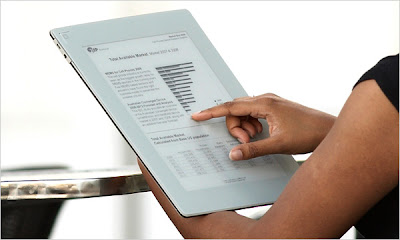
Unlike tiny mobile phones and devices like the Kindle that are made to display text from books, these new gadgets, with screens roughly the size of a standard sheet of paper, could present much of the editorial and advertising content of traditional periodicals in generally the same format as they appear in print. And they might be a way to get readers to pay for those periodicals — something they have been reluctant to do on the Web.
Such e-reading devices are due in the next year from a range of companies, including the News Corporation, the magazine publisher Hearst and Plastic Logic, a well-financed start-up company that expects to start making digital newspaper readers by the end of the year at a plant in Dresden, Germany.
But it is Amazon, maker of the Kindle, that appears to be first in line to try throwing an electronic life preserver to old-media companies. As early as this week, according to people briefed on the online retailer’s plans, Amazon will introduce a larger version of its Kindle wireless device tailored for displaying newspapers, magazines and perhaps textbooks.
An Amazon spokesman would not comment, but some news organizations, including The New York Times, are expected to be involved in the introduction of the device, according to people briefed on the plans. A spokeswoman for The Times, Catherine J. Mathis, said she could not comment on the company’s relationship with Amazon.
These devices from Amazon and other manufacturers offer an almost irresistible proposition to newspaper and magazine industries. They would allow publishers to save millions on the cost of printing and distributing their publications, at precisely a time when their businesses are under historic levels of pressure.
“We are looking at this with a great deal of interest,” said John Ridding, the chief executive of the 121-year-old, salmon-colored British newspaper The Financial Times. “The severe double whammy of the recession and the structural shift to the Internet has created an urgency that has rightly focused attention on these devices.”
Perhaps most appealing about this new class of reading gadgets is the opportunity they offer publishers to rethink their strategy in a rapidly evolving digital world. The move by newspapers and magazines to make their material freely available on the Web is now viewed by many as a critical blunder that encouraged readers to stop paying for the print versions. And publishers have found that they were not prepared to deal with the recent rapid decline of print advertising revenue.
Publishers could possibly use these new mobile reading devices to hit the reset button and return in some form to their original business model: selling subscriptions, and supporting their articles with ads.
The current version of the Kindle has proved in a limited way that this is possible. Even though its six-inch black-and-white screen is made for reading books, Amazon offers Kindle owners subscriptions to more than 58 newspapers and magazines, including The Times, Newsweek and The Wall Street Journal. (The Journal subscription costs $9.99 a month, The Times is $13.99 a month and The New Yorker is $2.99 a month.)
Subscribers get updates once a day over a cellular network. Amazon and other participating publishers say they are satisfied with the results, although they have not released data on the number of subscriptions that have been sold.
For the all the hope publishers are placing in dedicated electronic reading devices, they will be encumbered at the start with some serious shortcomings. Most use display technology from E Ink, a company in Cambridge, Mass., that was founded in 1997 based on research started at the Massachusetts Institute of Technology M.I.T. Media Lab to develop thin electronic displays capable of mimicking the readability of regular paper, while using a minimum amount of battery power.
The screens, which are currently in the Kindle and Sony Reader, display no color or video and update images at a slower rate than traditional computer screens. That has some people in the magazine industry, in particular, keeping their hopes in check until E Ink evolves.
“I don’t think we would be anywhere near as excited about anything in black and white as we would about high-definition color,” said Tom Wallace, the editorial director of Condé Nast, publisher of glossy magazines like Vogue and Wired. “But technology changes at a pretty high clip these days, and if we are now in the Farmer Gray days, it will be only a very short while until we are in the video game era.”
Another hitch is that some makers of reading devices, like Amazon, want to set their own subscription prices for publications and control the relationship with the subscriber — something media companies like Condé Nast object to. Plastic Logic and Hearst have said publicly that they will take a more open approach and let media companies deal directly with readers and set their own prices.
Then there is the looming presence of Apple, which seems likely to introduce a multipurpose tablet computer later this year, according to rumor and speculation by Apple observers. Such a device, with a screen that is said to be about three or four times as large as the iPhone’s, would have an LCD screen capable of showing rich color and video, and people could use it to browse the Web.
Even if such a device has limited battery life and strains readers’ eyes, for many buyers it could be a more appealing alternative to devices dedicated to reading books, newspapers and magazines.
Such a Web-connected tablet would also pose a problem for any print publications that hope to try charging for content that is tailored for mobile devices, since users could just visit their free sites on the Internet. One way to counter this might be to borrow from the cellphone model and offer specialized reading devices free or at a discount to people who commit to, say, a one-year subscription.
Then there is the possibility that all these devices from Amazon, Apple and the rest have simply not appeared in time to save many players in the troubled realm of print media.
“If these devices had been ready for the general consumer market five years ago, we probably could have taken advantage of them quickly,” said Roger Fidler, the program director for digital publishing at the University of Missouri, Columbia. “Now the earliest we might see large-scale consumer adoption is next year, and unlike the iPod it’s going to be a slower process migrating people from print to the device.”
“And all of us are very worried about how newspapers are going to survive in the next few years if we don’t see any turnaround in the economy,” Mr. Fidler said.
Whether or not the situation is hopeless, newspapers and magazines now find themselves weighing offers of aid from outsiders. When asked at the debut of the Kindle 2 in February whether the Kindle could help the print media, Jeffrey P. Bezos, Amazon’s founder and chief executive, said he thought there were “genuine opportunities” to save journalism.
“And we’re excited about helping with that,” he added.
Sources: The new York Times
